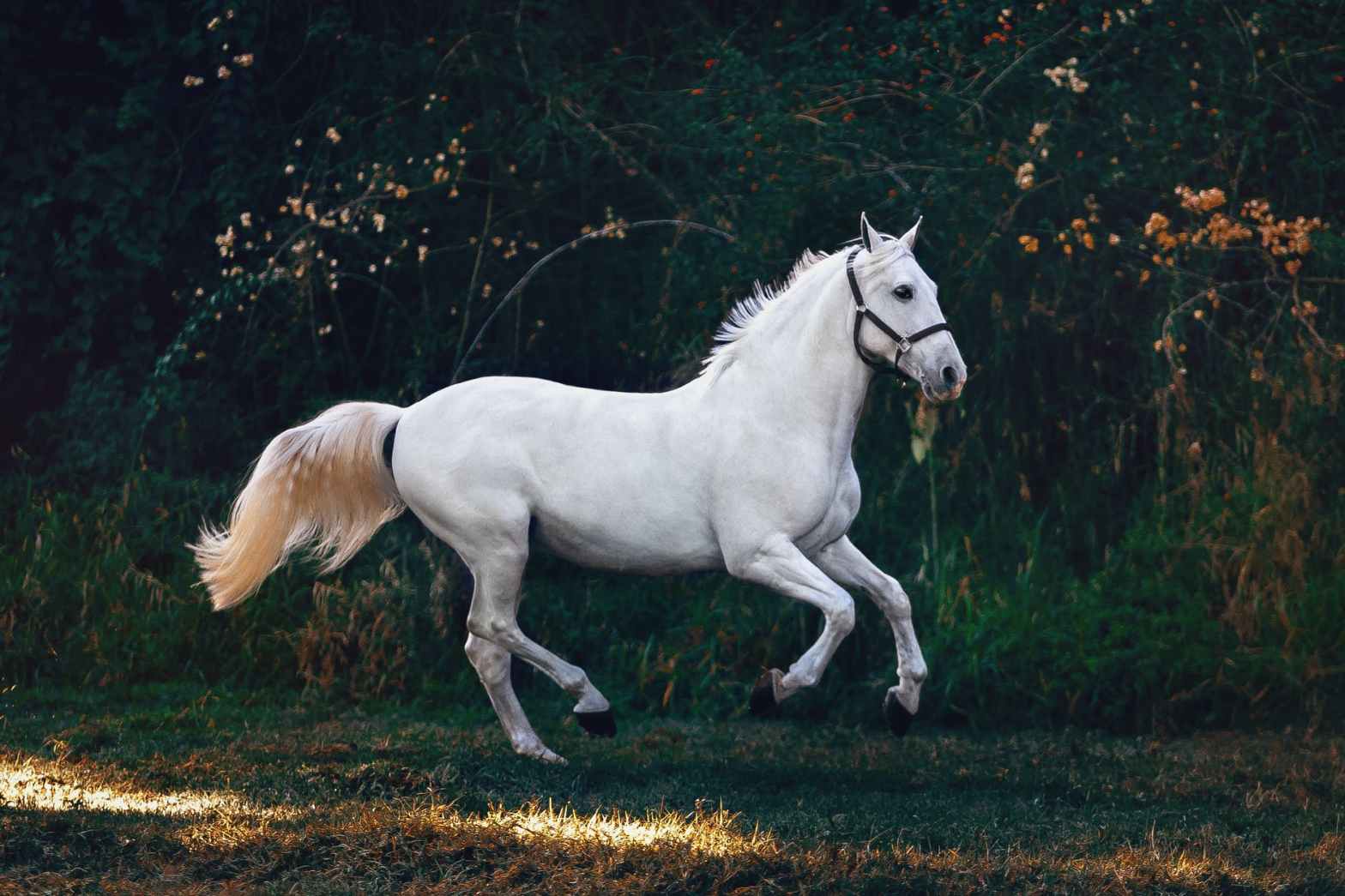
Prior to diving even deeper into my tragedy, I thought it would be pertinent to take a break from the doom and gloom with a more uplifting story. This is the story of what I accredit much of my strength and resilience to: the horses.
When I was growing up, like many little girls, I always wanted a pony. When I was 10 years old, my dad surprised me by taking me to a barn where I was introduced to my first horse: a 15.3 hand tall, grey Arabian gelding named Sequoi. A white horse! I couldn’t believe it! I thought he was made of magic. My dad had seen an ad in the classifieds for a horse for lease. Technically for sub-lease, as the woman who owned him didn’t ride horses anymore and was leasing him to a lady named Terry. Terry was a horse trainer and taught riding lessons. She was using Sequoi as one of her lesson horses but to help make ends meet, she had decided to do a sub-lease on him. This meant that she would still be primarily responsible for his board and care and she would still be using him as a lesson horse for her students. But, when he wasn’t being used for a lesson, he was mine to ride and care for.
I didn’t know anything about horses at first. I began taking lessons from Terry right away. If you aren’t familiar with horse sizing, 1 hand equals 4 inches, so 15.3 hands equals 63 inches or 5.25 feet and is measured at the withers (top of the shoulder). I’m not sure how tall I was at 10 years old, but I do remember having to jump to reach the top of his back. An average 10-year-old girl weighs about 70 lbs and an average horse that size weighs over 1,000 lbs. Sequoi was a lesson horse but he was not a very good one. That is to say that he was neither docile nor good natured like lessons horses should be. In fact, he was ill tempered and intolerant of being ridden much of the time. But he was my horse, so I learned how to ride him. Once I actually started to ride, I became scared of him pretty quickly. He rarely did what I asked him to and when he was done with me, he would rear up or try to buck me off. I very much wanted a horse though, so I continued to try. Terry was a stocky, no-nonsense woman with short hair and gruff voice to go with her demeanor. I was equally afraid of her as I was of the horse, so when she told me to do something with him, I just did it—no matter how frightened I was.
About a year after beginning to ride, I entered my first horse show on Sequoi. It was a zone show, which is a step above 4-H in level but below the level that professionals show in, which are called “A system shows”. It was held at a venue in Clearview called Bits and Spurs. Bits and Spurs was an outdoor arena that got very muddy and slick when it rained. And boy did it rain that day. I was showing saddle seat pleasure which is a sort of flashy style where the horse carries its head high and really picks up its feet when it moves. The rider sits up very tall and straight with hands held high, wearing a suit and tie with shiny boots and a formal brimmed hat. The saddle is small and flat, and the bridle has two bits connected to two sets of reins. By the end of the day, I was completely drenched and my brand-new show hat was ruined (they have plastic covers you can put on them but I didn’t know that yet). But hat covers were not the only thing I learned about that day. I also learned that Sequoi hated to be ridden in horse shows. After initially refusing to enter the show ring and needing to be coaxed in from the ground by Terry with a show crop, he proceeded to attempt to remove me from his back for the remainder of the class. A class lasts about 20-30 minutes and Sequoi spent the entire time trying his best to buck me off. I wasn’t a very skilled rider at that time, and I didn’t even realize what was happening. I was scared of course, but Terry was standing outside the arena and every time I passed her, she would yell at me to get his head up.
You see, in order to really buck hard a horse needs to have its head between its legs down by the ground. As long as you can keep their head up, they can only buck so hard. So while he pulled on the reins trying to get his head low as he bucked around the ring, I pulled back. Whenever we passed Terry, she would scream at me to pull harder, so I pulled harder. By the time the class was over my arms felt like they were going to fall off and I was pretty shaken up. My mom would later tell me how she had seen Terry shaking her head and looking at me and Sequoi in that ring with bewilderment, when my mom asked her why, Terry had said “I don’t know how that tiny little girl is holding that huge horse’s head up that way, using brute force and sheer will power, but she is.” And when we came out of the ring, Terry told me it was time to get ready for the next class, so I did just that. I spent the rest of the day battling with a crazed horse who wanted me off his back at all costs through the slick mud of the show arena at Bits and Spurs. Not all the shows that season were as wet as the first, but they all involved me riding a bucking horse round and round an arena while the judges evaluated my performance. I didn’t know it at the time, but all this would serve to somewhat prepare me for my next horse, Spuds.
Spuds was the first horse I owned. Her registered name was ANW Showquest. She was a big, chestnut mare and I decided that she looked like a large potato and nicknamed her Spuds. She was a 3-year-old Arabian, and she was unbroken to saddle when I bought her. She came from out in a pasture and had not been worked with much. To put it bluntly, Spuds was a demented hellcat of a horse. My trainer started to ride her soon after bringing her to the barn and Spuds did everything in her power to make that as difficult as possible. She spooked, reared, bucked, and bolted around the arena the entire time she was being ridden. As I was only 11 at the time and not yet a very seasoned rider, I was not allowed on her right off the bat. I remember the first time I got on her back. I showed up at the barn that day, a few months after purchasing her, and Terry announced that I would be riding Spuds. My heart leapt into my throat and I immediately panicked, but as I said before, I did what Terry told me to do, so I proceeded to saddle up my horse. Terry had me put a western saddle on her because western saddles are big and have more support for the rider as well as having a saddle horn which can be used to help hold on in the case of a bumpy ride. There were two trainers that worked at the barn, Terry and a woman named Gale. Gale was conducting a group lesson in the arena that day. When she looked over and saw me atop Spuds’s back she let out an exclamation and said, “Is that Tisha riding Spuds??” She immediately ordered everyone else out of the arena which did nothing to improve my comfort level with the situation. My first time riding Spuds didn’t go too badly but that was soon to change.
True to her nature, Spuds didn’t care to do what I asked her while I was on her back, she took to bucking and rearing in retaliation. So, Terry came up with a solution. One day, shortly thereafter, I lead Spuds into an empty arena. I mounted the mare and Terry handed me a riding crop and told me to give my horse her head. “Why?” I asked in terror. “Just do it, loop the reins around the horn and hold on”. “Why?” I asked again, my stomach in knots, but I did as I was told. “Now ask her to move forward” Terry commanded. I asked my horse to move forward which to no one’s surprise she did not do. “Hit her with the crop” Terry told me. I gave the horse a tap on her rear end with my riding crop. Spuds gave a little buck. “Again, harder this time.” I gave her a harder tap and she gave me a harder buck. It was not long before we were slowly making our way around the empty arena, Spuds with her head between her legs bucking like a true bronco and me tapping her on the rear with my riding crop while white knuckling the saddle horn with my other hand and barley holding back tears. Terry was walking slowly beside us yelling “AGAIN!” each time Spuds bucked. It went on like this for what felt like a very long time, until finally, when I gave Spuds a whack, instead of bucking, the horse took off running. This was apparently the desired result because Terry began cheering and I was allowed to stop my horse and dismount for the day. And so, at 11 years old, I got my first lesson in bucking out a horse. It was not the only time I would have to do this with Spuds, but each time got shorter with longer intervals in-between. Spuds learned that I was not going to give up no matter what she did and gradually began to respect and trust me. I had similar experiences with Spuds on the ground when she didn’t care to do something a had asked of her, with her rearing up and trying to strike me with her front hooves repeatedly. I would keep a hold on her lead and puffing up my tiny frame as big as I could, I would square myself up with her shoulder, raise my free arm in a commanding manner, look her directly in the eye and walk purposefully toward her being careful not to get struck by her attempted blows. I would keep myself carefully positioned off to the side, between her head and her withers. As long as I maintained this position, she could not quite get me with her hooves. Eventually she realized that I was not going to back down and she gave in and did what I was asking of her.
If all of this sounds dangerous to you, you are correct—it is. A horse standing on its hind legs towers well over 10 feet tall and the powerful blows she was attempting would have seriously injured and possibly even killed me if she had managed to land one. Horses are powerful animals, and show horses, particularly saddle seat pleasure horses, have an added spirit that makes them even more treacherous to handle. Even ones that are not slightly mean spirited like Spuds are flighty and unpredictable. Horses are prey animals and as such depend on flight as their primary means of survival. They have a reaction known in the equestrian world as “spooking”. Spooking is akin to when a person is startled and jumps, except a horse jumps extra big (sometimes several feet directly to the side) often times bolting after. This reaction is so strong and sudden that a rider who hasn’t anticipated the spook or doesn’t have a steady seat can find himself remaining in the original location (but on the ground now rather than on the horses back) while his horse is somewhere else completely. For an inattentive handler on the ground, it can mean being trampled. People who work with these types of high-strung horses learn very quickly to keep their senses in a heightened state at all times. You learn to be aware of your horse: What is their mood? Where are they looking? What is the direction of their ears telling you? Which muscles are flexed? You learn to be aware of your environment: What sounds are around you? Are you coming up on a spot that might be frightening to your horse? What are the other horses/people/cars/birds/everything doing around you? And you learn to be aware of yourself: What message is your energy and body language sending to your horse? Are you relaxed? Are you afraid? Can your horse feel your emotions? You learn to anticipate and prepare for every possible scenario, your safety, your horse’s safety, and the safety of others around you depends on it.
Horses are extremely sensitive and will pick up on very subtle movements and energy shifts. They will also speak to you in the same manner, letting you know how they feel or that something is going to go wrong with tiny, almost indetectable cues that would be missed by the untrained eye. Have you ever watched a dressage horse and rider preform? They appear to move effortlessly through their routine as if they are communicating via telepathy. The type of riding I did was along the same lines as dressage, and I can tell you that in reality, the communication between horse and rider falls just short of telepathy. It is a fine-tuned art of reading cues and body language. It takes a lot of practice and dedication as well as years of experience to reach this level of horsemanship. But it is well worth the effort, as the bond you experience with a horse at this level is indescribable. There is no feeling in the world that quite matches that of becoming one with such a powerful and majestic creature. And the journey brings lessons that cannot help but carry over into all aspects of one’s life: lessons in awareness, in courage, in determination, lessons in sheer grit.
When I was around 12, I decided it would be fun to join 4-H so I could show in the Evergreen State Fair. 4-H is geared toward kids who have a horse as a backyard pet, or who ride at a more recreational (less competitive) level. But, participating in the fair seemed like it would be cool so I decided to try it. It didn’t turn out as enjoyable as I had hoped. Spuds just wasn’t a backyard or recreational kind of horse. For starters, she was territorial in her stall and would charge at, bite, and kick anyone who attempted to enter. This was a major issue because the State Fair gives out awards to 4-H clubs that keep the stalls and aisle in their section immaculately clean. Each club assigns a rotation to their members for cleaning duty. The assigned cleaners are to keep the aisle swept and remove manure from the stalls promptly. I explained to them that it was not safe to go in Spuds’s stall and I put a sign on her stall letting fair goers know that this particular horse liked to bite so they should not attempt to pet her. The 4-H club was not happy about my request that they not enter her stall, but I was very firm on the matter and agreed to return every hour to check if there was any manure that needed to be removed. During one of these hourly manure checks I was greeted by the very upset parent of one of my fellow club members. Apparently, her daughter had seen a pile of manure in Spuds’s stall and decided to go in and grab it. To their horror, Spuds had attacked her. The girl had managed to jump out of the way unharmed, but Spuds had bolted from the stall and it took several people to catch her and get her back in.
The second incident at the fair happened in the showmanship arena. Showmanship is an in-hand class where the handler leads their horse around the arena and performs certain maneuvers and patterns. The showmanship class was large, around 30 entries that year, and was held in the outdoor covered arena. The problem with the outdoor covered arena is that, during the fair, they turn the rides (which are located just outside the far end of the arena) on at noon. I was aware of this, as a handler of a horse like Spuds needs to be, and I had checked the class time prior to registering to be sure I would be out of the arena before noon. Unfortunately, due to the large number of entries, the class ran long. As it turned out, my position in the ring that day was all the way down at the far end of the arena, next to the rides. I wasn’t wearing a watch, but I knew the class was running over. I could see the ride operators beginning to prepare to fire up the engines. I kept glancing down the arena to see if the last competitor had finished, finally everyone had. But, as we were standing there waiting for the results to come in, the inevitable happened and the first ride began to hum and clank into gear. Spuds responded as any crazed, maniac horse should…she spooked. She jumped several feet sideways and landed, slamming into the horse next to us. She then immediately bolted forward hitting the end of the lead and I quickly spun her around in a circle. I saw the handler of the horse Spuds had collided with fall to the ground and I felt terrible as I began to slowly make my way down the long arena to the entry gate at the other end.
Spuds continued to jump and try to bolt, nostrils flaring, snorting out hot breaths of air. I maintained control over her by progressing in a series of tiny circles down the length of the arena in front of the line of competitors awaiting the class’s results. They were facing me as I moved between them and the fence of the arena, where the spectators were standing to watch. At one point, fearing for my safety, a well-intentioned father of one of the other girls jumped into the ring to rescue me from my demonic horse. I had to forcefully inform him that I was, in fact, fine and that it was he whose safety was in jeopardy if he attempted to intervein. Never has an arena seemed so long. I had plenty of time during this walk of shame for the reality that Spuds and I did not belong at a 4-H horse show or the fair to really sink in.
I would go on to purchase a beautiful, well bred, Morgan mare named Amigo Alexis. Alexis was the most gental, kind horse—a dark brown chestnut with a flaxen mane and tail. Together we performed in A-circuit, breed shows in the Saddle Seat Pleasure arena. I also showed in-hand and driving classes. Over the years I would dabble in jumping and reigning as well, but I never competed in those disciplines. I spent countless hours at the barn training, going on trail rides, mucking out stalls, grooming, and just simply being with the horses. My barn friends and I—being kids—engaged in the usual, less-than-safe choices of laying with our horses in their stalls while sharing carrots with them and jumping on their backs without a saddle or bridle when they were turned out to pasture, enjoying the wind in our faces as we raced across the fields.
I could fill an entire book with stories from those days, but I will leave it at this: my equestrian years gave me the strength and resilience to move past many hurdles in my life. Someone once said to me “Tisha, you don’t seem like you’re scared of anything.” “Quite the contrary,” I told them, “I have always been scared of pretty much everything. But the thing about always being scared, is that you have to learn to always be brave. You don’t have any other option.”
“Courage is being scared to death but saddling up anyway.” – John Wayne

 Patchwork Girl